My professor once told me - “Teaching is a very spiritual thing for me. Nowhere else do I find myself in a position, except classrooms, where the reasons for me to delve deep into myself and my truth are right in front of me. Teaching puts me in a position where I am almost compelled to discover my truth on a daily basis. Each student and their framework of thinking is a new reason and a new company to go in search of my truth”.
Since the day I heard this, I can’t help but think about it at least once, when I teach in my classrooms. Every new question from a student feels like a hand reaching out to yours, in order to walk together towards the truth. But I feel, beyond the spiritual, there are also the magical, in teaching. These are the moments when, not one, but the entire class starts marching towards truth and you just happily walk along. These are instances where the labels - student and teacher are deciduously shed and the room is filled with fellow truth-seekers, marching along the blossoming spring of human togetherness.
One such instance happened in the classroom today. The batch of students (agegroup - 11 to 14) have been learning the history of India’s freedom struggle for the past few months. Gandhi, Tagore, Ambedkar, Nehru and many others were summoned to our classrooms, their ideas discussed and debated. After our period of study, we proceeded to a module of creation.
The module of creation has two tangible creations as its objective: -
- The student has to choose a work of art made during and pertaining to India’s freedom struggle and present it to the classroom. Their presentation must answer two questions: Why did they choose that particular work of art? How is the work of art connected to India’s freedom struggle?
- Produce any work of art of their own (either individually or as groups) that embodies the idea of freedom.
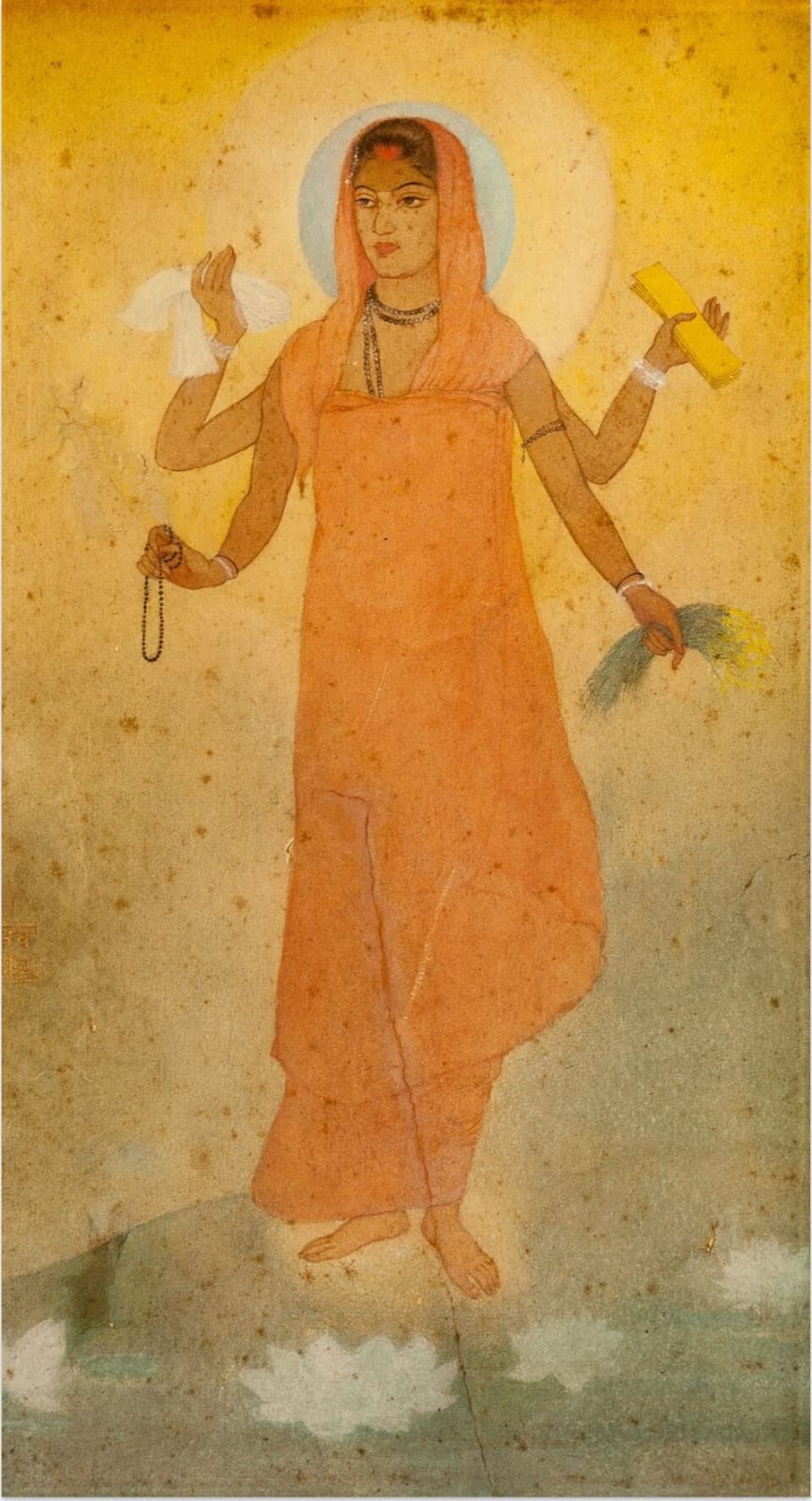
We had the first round of presentations in class today. The students had chosen various works of art and made their presentations. Rabindranath Tagore, Bakim Chandhra Chatarjee and Nandalal Bose were among the artists whose works were presented. Coincidentally, 5 students had chosen “Mother India” by Abanindranath Tagore. Each of them provided their own interpretation of the painting and argued in their ways, about the reason for their choice and the relevance of the work in the scene of India’s freedom struggle. Some found the crop and the white garment in the hands of Mother India to be reflective of the spirit of the Swadeshi Movement - a collective striving to obtain self-reliance.
One student however, brought up Gandhi while discussing this painting. “What I find interesting about this work, is not just its content, but Gandhi’s comment on it too,” he said. “Gandhi says this cannot be Mother India” he continued. With the entire class chanting “why??!! Why would he say that??!!” our man decided to elaborate.
“Gandhi observes that Mother India looks like Hindu Goddess. Four arms holding different things, saffron colour garments, lotuses on the floor and the overall outlook makes her look very “Hindu”. Gandhi says that this cannot be the mother of a nation that also has Muslims living in it. I find this conflict very interesting and Gandhi’s comments to be valid. That is why I chose this work.” he concluded.
Soon, the class erupted with ideas, trying to approve, counter or resolve this argument.
“The Muslims worship Allah. He has no form and he is present everywhere. Why can’t Allah be in the form of a Hindu Goddess?” a student argued.
“See… Allah does not have a form, but Hindu Gods do. Mother India in this painting clearly looks Hindu” another student shot.
“And, Allah may not have a form, but Muslims have a form” another suggested.
“They have to be represented too” somebody approved.
“Not just them, this country also has Christians, Buddhists, Parsis and Sikhs living here. They also have to be part of this” somebody else suggested.
“Guys, Hinduism, Christianity, Islam and Buddhism finally takes us to the idea of a formless God, divinity. If these are also the names that are going to separate people, then, only the God of a country can bring them all together. Does it really matter what form she is? God is formless anyways!” a student proclaimed.
The silent beholders of this were all cheerful and eager smiles. Devil, in the form of time and the education system put an abrupt end to this discussion, leaving us all sighing.
WIth the utmost excitement I say - to be continued…