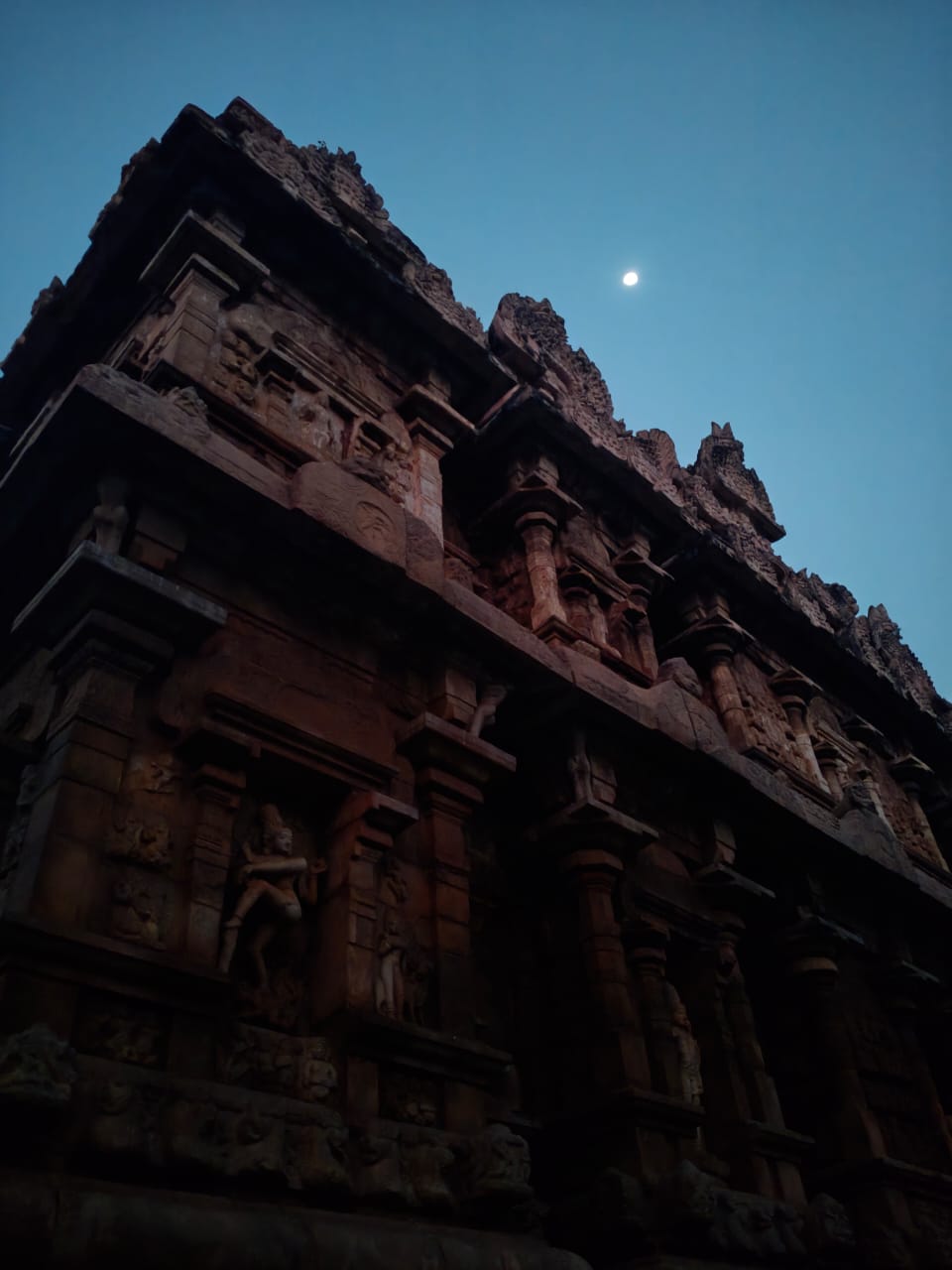
Recently, I had the chance to look at the inner chamber of the vimana at the Gangaikonda Cholpauram temple. An experience that felt like taking a privileged peek into the subconscious of a monument that is considered a pinnacle of South Indian temple architecture. Above the garbha griha in the temple, there is a vast empty chamber in the vimana. The ceiling of this chamber, built with brick and limestone plaster, constitutes the inner wall of the vimana. This ceiling is built by tapering and layering several brick rows on top of another (to form a pyramid of concentric shapes to form a tower), that convene below the globular shikara on the top. The entire chamber can be seen from the top tier of the vimana.
The sight of the inner chamber was a testimony to the enormity of human creativity. It was evidence that notorious minds, audacious enough to imagine the possibility of building such a structure, roamed this land centuries ago! Their society nurtured these minds, believed in their vision and undertook a glorious collaboration that culminated in the construction of one of the most monumental structures in the history of humankind.
The inner chamber (the portion of the temple that I consider to be the closest to the idea of the temple), was equally a peek into the minds of a society that thrived on this planet ages ago. Even more so, it was a peek into the dreams of that society! Nearly a thousand-year-old dreams were laid out in front of me in naked grandiosity! There was freakish nostalgia in beholding that sight. I come back to write this, not to narrate the experience, but to produce a testimony of my own to the magic of merely witnessing that sight. I write this to sow my dream in the fertile emptiness of that chamber!
Oftentimes, we get confused between a vimana and a gopura. The gopura is an arch or tower that is built in the entrances of temples, while the vimana is a super-structure built on top of the garbha griha (sanctum). The word vimana denotes something that can fly, or something that leaves the earth (ground). We are all familiar with Ravana’s Pushpaka vimana from the Ramayana. Likewise, the portion of the temple that attempts to leave the ground (rather, plummet from the ground) is the vimana. While the other parts of a temple (mantapa, prakara, etc) are built to fall towards the ground, it is the vimana that attempts a flight. There is literally and symbolically an elevation that is implicit in the structure of the vimana.
According to the agama(s), the vimana of the Gangaikonda Cholapuram temple is classified as a “sandhara” vimana. The word “sandhara” refers to the pradhakshina pada (circumambulatory path) built in between the inner and the outer walls of the vimana. So, the vimanas with the provisional gap between the inner and outer walls for the construction of a circumambulatory path is classified as a sandhara vimana. The vimanas with outer and inner walls built adjacent to each other (without the gap) are classified as “asandhara” vimanas. Some of the earliest sandhara vimanas can be seen in the Kanchi Kailasanatha temple and the Vijayalaya Choleshwaram temple complex (in Narthamalai, Pudukottai).
A more recent and popular sandhara vimana that we know of is from the Periya Kovil in Thanjavur, commissioned by Rajaraja Chola 1 (the father of Rajendra Chola 1, who commissioned the Gangaikonda Cholapuram temple). The sandhara in Periya Kovil is two-storeyed. The second storey houses the sculptures of the 108 karana(s) in bharathanatyam (listed in bharatamuni’s natyashastra). (The karana sculpture series in the second tier of the Periya Kovil sandhara is unfinished. Only 83 sculptures were completed).
The temple plan (and the layout of the vimana in particular) of the Gangaikonda Cholapuram temple is heavily inspired by the Periya Kovil, Thanjavur. It is often described as its feminine counterpart. Both the vimanas are stylistically very similar. The garbha grigha is enclosed by a two-storeyed sandhara. Originally, the garbha grihas (housing the Shiva lingas) and the entire inner portion of the vimanas in both these temples were undisrupted and completely hollow. Later, ceilings were built on top of the Shiva Lingas in order to prevent bird and bat excreta from falling on the deity. The inner and outer walls of the vimana meet at the top of the sandhara (forming a beautiful cascading pattern on the roof) and rise adjacently towards the bulbous shikara on the top. The super-structure above the sandhara is 13-storeyed in Thanjavur and 9-storeyed in Gangaikonda Cholapuram. Popular lore has it that Rajendra Chola wanted to build a vimana taller than what his father had built in Thanjavur, but failed because of soil erosion in the temple’s foundation due to excessive weight. So, he had to cap the structure after the 9th storey. Some even claim that there is an observable tilt in the 9th tier, supposedly caused by the erosion. All these claims are heavily contested.
Though it is evident that Gangaikonda Cholapuram borrows many of its elementary features from the Periya Kovil, it has a profoundly original architectural idea that easily transcends its contemporary influences. Far from being a modified reconstruction of its influences, Gangaikonda Cholapuram presents a novel architectural idea and challenges itself to preserve it for posterity.
If Periya Kovil’s originality is its attempt towards unprecedented magnificence, Gangaikonda Cholapuram is profoundly original in its attempt towards concealment. In other words, the novel idea of the monument seems to manifest in what the structure does not show (and for that matter, cannot show) to its beholder. This manifest concealment does not seem like an attempt to hide, disguise or create illusions of appearances. Rather, this concealment seems to be an attempt to capture (or to realize) that which we can never see; that which is forever concealed.
A temple, by definition, is a monument that is built to host God and present it to the people. The primary mode for people to witness the presentation is by having a darsana (sacred beholding) of God. The most elementary form of this presentation is done by presencing God in a vigraha (idol) and installing it in the garbha griha. The basic layout of the temple is structured in a manner that indicates the presence of the divine in the garbha griha. This is common to most temples.
However, temples acquire their uniqueness through the ancillary means of presentation that they carry out. It may be ritualistic presentation, narrative presentation, architectural presentation, etc. The first two are intangible and may vary considerably over time. However, the architecture of a temple is tangible and mostly remains unchanged (though there may be renovations and structural additions). The architectural presentation is carried out by making the structures assume and invoke an attribute of God (that is either particular to the deity, or a cosmic characteristic that is also manifest in the deity). The Periya Kovil in Thanjavur presents the divine in its sheer magnificence and grandiose (an attribute that is often used to describe the cosmic scale of divine presence and activity).
The Gangaikonda Cholapuram temple presents the divine in its concealment. According to Shaiva Siddanta, concealment is among the five actions or duties (Panchakriya in Samskrutham and Ainthozhil in Tamizh) of God, alongside creation, preservation, destruction and revelation (or bestowing of grace). “To conceal” is seen as an act of the divine. Therefore, concealment becomes the attribute of the divine. Then, the indication to this concealment in reality, to those things that remain forever hidden to the human gaze, is an indication to the active presence of the divine.
The monument seems to gain its profoundly unique architectural personality in repeatedly indicating this concealment in multiple instances and layers. There is a recurring attempt to scale towards that which is forever concealed. I wish to draw a parallel to some musical ideas that capture silence as their central quality (take for instance, Gustav Mahler’s Symphony No 1). Similarly, the monument repeatedly tries to show what one can never see. In both these cases, there is a striving to hear what one can never hear and see what one can never see. Hearing and vision are utilized to realize the presence of something that is beyond its confines. Its sight, or rather its beholding, is presented to us through its concealment. This, I find to be a defining tendency of the idea behind the Gangaikonda Cholapuram temple. What I saw in the inner chamber of the temple’s vimana, is a raw, crude and daringly naked exposition of it.
In the case of Periya Kovil, the outer wall rises to the shikara as tapering squares, forming the pyramidal structure. The inner wall (seen from the inner chamber of the vimana) begins to ascend as tapering squares, but gradually turns into circles as it progresses towards the shikara. These massive inner and outer walls are erected separately from the foundation and are merged together at the top of the sandhara in the second storey. This merging is done by building cascading rows from both the walls (a brilliant technique for weight balance) that adjoin at some point and rise together as a single wall. The sheer size and massiveness of this structure makes us realize the magnificence of the idea (and consequently, the divine as well) behind the Periya Kovil.
However, at Gangaikonda Cholapuram things are curiously different! The structure of the vimana is perhaps one of the greatest play in architectural forms. The outer wall of the vimana has a portion on all four sides that protrudes from the original structure. This very explicitly disrupts the notion of a pyramidal vimana. This structural projection is called a badhra sala in the agama(s). Though the badhra sala cannot be built without reference to the original pyramidal structure, its construction defies the very notion of a pyramid (by giving the vimana a whole new appearance).
The inner wall begins to ascend as tapering squares. Gradually, the squares turn into hexagons and then octagons and then finally become circles as they rise towards the shikara. All these shapes are constructed in reference to the circular foundation of the Shiva Linga in the garba griha. Therefore, it wouldn’t be wrong to say that the inner wall begins its journey towards the shikara as a circle. The inner wall shows us a gradual progression from circle, to a square, to a hexagon, to an octagon and finally becomes a circle again. This sequence conceals all these polygons in a circle by making them arise from and dissolve into one, indicating the origination and evanescence of shapes in a circle.
Looking at this, I was reminded of an essay by Isaac Asimov (introduced to me by a teacher) on extra-terrestrial life. The essay raises one very fundamental question– how can we know if there is life on a planet that has been newly discovered? To this, one of the many answers Asimov provides is to spot the shapes on the surface of the planet. He says that if there are any other recognizable shapes apart from circles, we can be certain that there is life on that planet. This is because the circle is the only naturally occurring shape. Any other recognizable shape is a product of intelligence.
It felt almost revelatory to observe that the inner wall of the Gangaikonda Cholapuram temple was demonstrating a progression of shapes from and to the only naturally occurring shape. Within the bandwidth of a naturally occurring circle, the temple conceals several other shapes that are the products of intelligence. From nature originated intelligence, and towards nature progressed intelligence, eventually merging with it and becoming one. This progression shows a picture that cannot be seen but can be realized through the concealment in the form. This is perhaps the most raw and expositorily naked indication to that concealment in the temple. The vimana has achieved its elevation in sophisticatedly submitting to its innate limitations– it does not surpass the confines of a circle, yet it elevates itself within it (like intelligence occurring in nature).
In the middle of the inner chamber, above the roof of the garba griha, there is a glass peephole to look at the Shiva Linga. I peeped into it to find myself standing on top of one of the largest Shiva Lingas in the world. A moment of intense elevation, only to look up and find myself standing below the grand confluence of shapes into the ultimate circle. There I stood, another dreamer in that eternal progression!